
Criminal Cases in the Stokes County Courts
Stokes County belongs to Superior Court, District Court, and Prosecutorial District 23. District Court hears misdemeanors and infractions and conducts the early stages of felony matters. Superior Court tries felonies and hears appeals from District Court. One Clerk of Superior Court keeps the criminal files for both divisions. No separate municipal criminal court serves King, Walnut Cove, or Danbury. Local cases instead enter North Carolina's unified General Court of Justice and remain with the Stokes County clerk.
Enterprise Justice case numbers combine a two-digit year, case-type letters, a six-digit sequence, and a three-digit county code. That full number is the best key for telling similar names apart and following a matter from one calendar to the next. The court file is case-centered. It tracks the charge accepted for prosecution, court assignments, hearings, motions, disposition, judgment, and sentence. It does not replace the sheriff's incident report or the jail booking record.
Stokes County Court Divisions
The division shown on a Stokes County criminal case affects both the stage and the record a reader should expect. A felony may begin before a magistrate and in District Court, then move to Superior Court after indictment or transfer. A misdemeanor generally stays in District Court. The Stokes court contact directory separates clerk, judge, magistrate, and district attorney numbers.
| Office | Criminal role | Contact |
|---|---|---|
| Clerk of Superior Court | Keeps District and Superior criminal files | 336-593-4400 |
| District Court | Misdemeanors, infractions, preliminary felony matters | Judges: 336-386-3712 |
| Superior Court | Felony trials and District Court appeals | Judges: 336-983-8989 |
| Magistrates | Initial process, appearance, and release functions | 336-593-4470 |
The official directory image below shows how Stokes County routes calls among these offices.
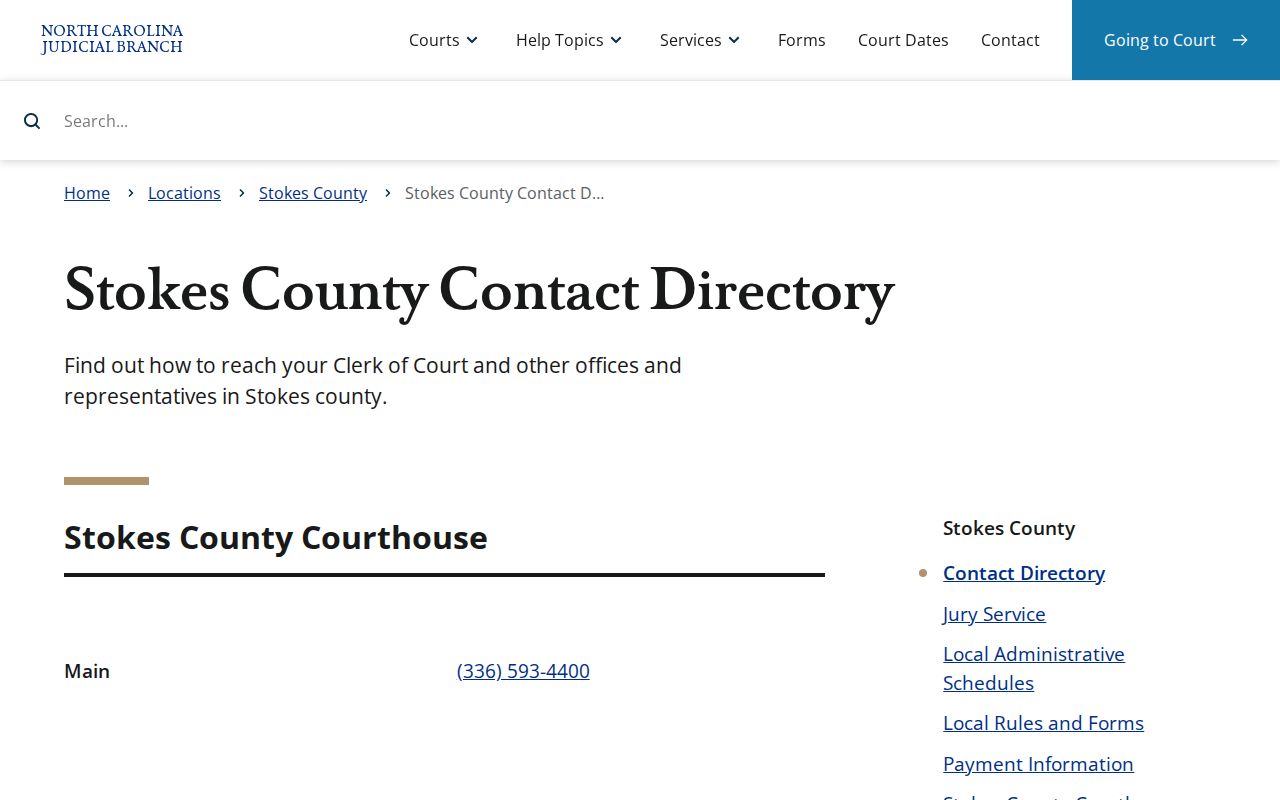
Use the clerk for the file itself; use the listed judicial office only for the type of court business that office handles.
How to Search Case Records
The free North Carolina eCourts Portal is the main remote channel for Stokes County criminal case records. Anonymous users can see public information without registering. Stokes joined Enterprise Justice in July 2025, so older paper-era material and newer electronic records can differ in depth. Smart Search may display a case summary, register of actions, parties, assignments, criminal actions, events, hearings, dispositions, financial information, and public documents. Portal training explains wildcard formats and filters.
- Open Portal and choose Smart Search for a case summary or register of actions.
- Enter the full case number when known. For a name search, follow the portal's wildcard rules.
- Set Location to Stokes County and Case Type to Criminal Actions, then narrow by birth date, status, or filing range.
- Open the matching case and compare parties, events, hearings, dispositions, and judgment information.
- Contact the Stokes County clerk for a certified result, a copy, or a file that does not appear online.
| Field Label | Type | Required | Notes |
|---|---|---|---|
| Party Name | Text | Route dependent | At least three last-name characters and one first-name character before wildcards |
| Record or Case Number | Text | Route dependent | Use the year, case letters, sequence, and county code |
| Date of Birth | Date filter | No | Helps separate people with similar names |
| Location | Advanced filter | No | Select Stokes County |
| Case Type and Status | Advanced filters | No | Choose Criminal Actions and open or disposed status as needed |
The official eCourts training page is shown below and is the best source when a field label or wildcard rule changes.
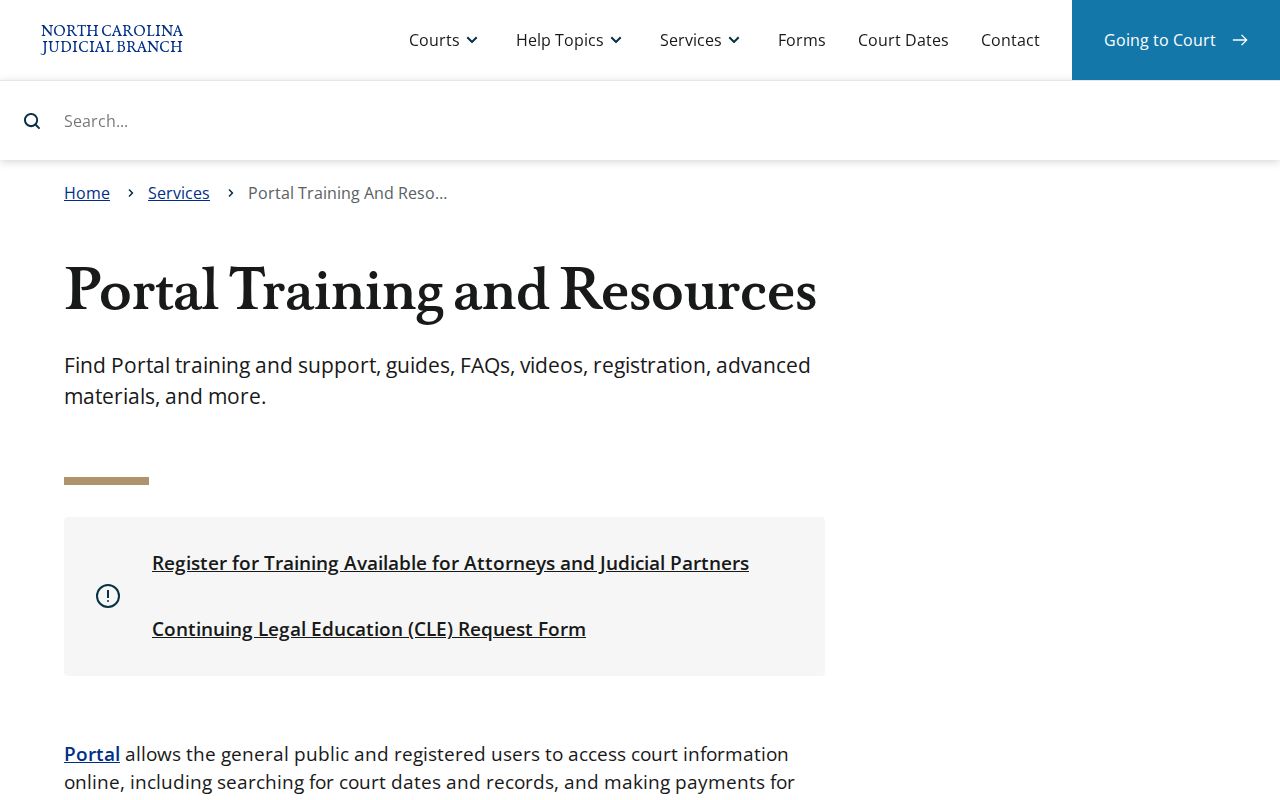
Portal training helps a Stokes County searcher distinguish Smart Search, judgment, and hearing tools before relying on a result.
Three Stokes County Case Searches
A portal result, court calendar, and certified clerk search are not interchangeable. Portal supplies free public case data from across North Carolina and can be filtered to Stokes County. The Court Dates search answers the narrower question of when a matter is scheduled. It accepts a name, citation number, and county, but a calendar row is not a complete case file. A $25 clerk-conducted search produces a certified Stokes-only criminal record result.
The official court-date interface pictured below is useful for an upcoming appearance, especially after a case number has been found.
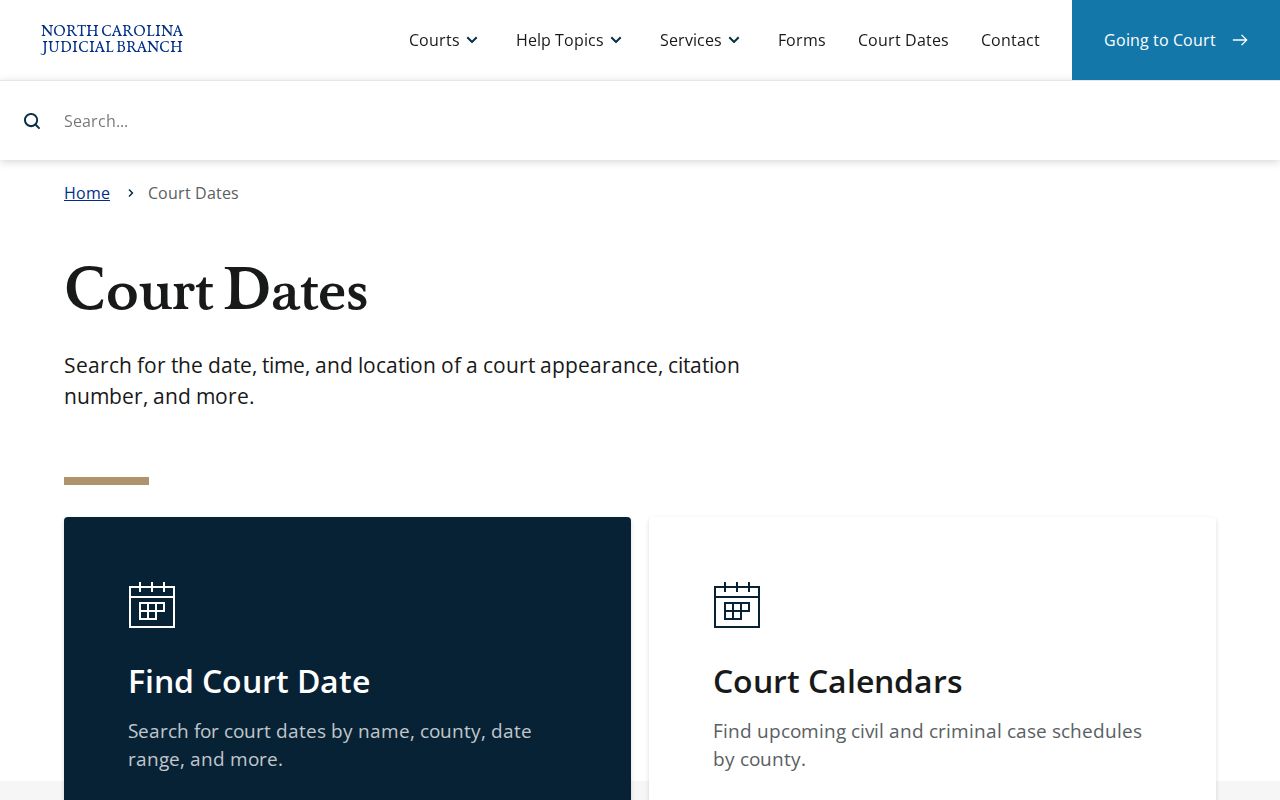
Always open the underlying Stokes County case in Portal or ask the clerk for the file when the outcome, charge history, or judgment matters.
What the Case File Shows
A Stokes County criminal case file joins the filed accusation to the court's action on it. The charging paper may be a complaint, citation, magistrate order, or indictment. A register of actions places later entries in date order. Hearings and assignments show where the case moved, while the disposition and judgment answer whether the charge ended in dismissal, acquittal, conviction, or another result. Financial fields may include costs, restitution, attorney fees, or supervision fees when public and applicable.
| Case Number & Court | Identifies the matter, year, court division, sequence, and county. |
|---|---|
| Charging Document | States the offense formally brought into the Stokes County court case. |
| Docket Entries | Lists filings, motions, notices, orders, and case events by date. |
| Hearing Dates | Shows scheduled and completed appearances when publicly available. |
| Disposition & Judgment | Records the outcome and the court's formal ruling. |
| Sentence & Conditions | Shows active, intermediate, or community punishment and public conditions. |
The Judicial Branch's court-record access overview explains which routes produce searches, copies, or certified results.
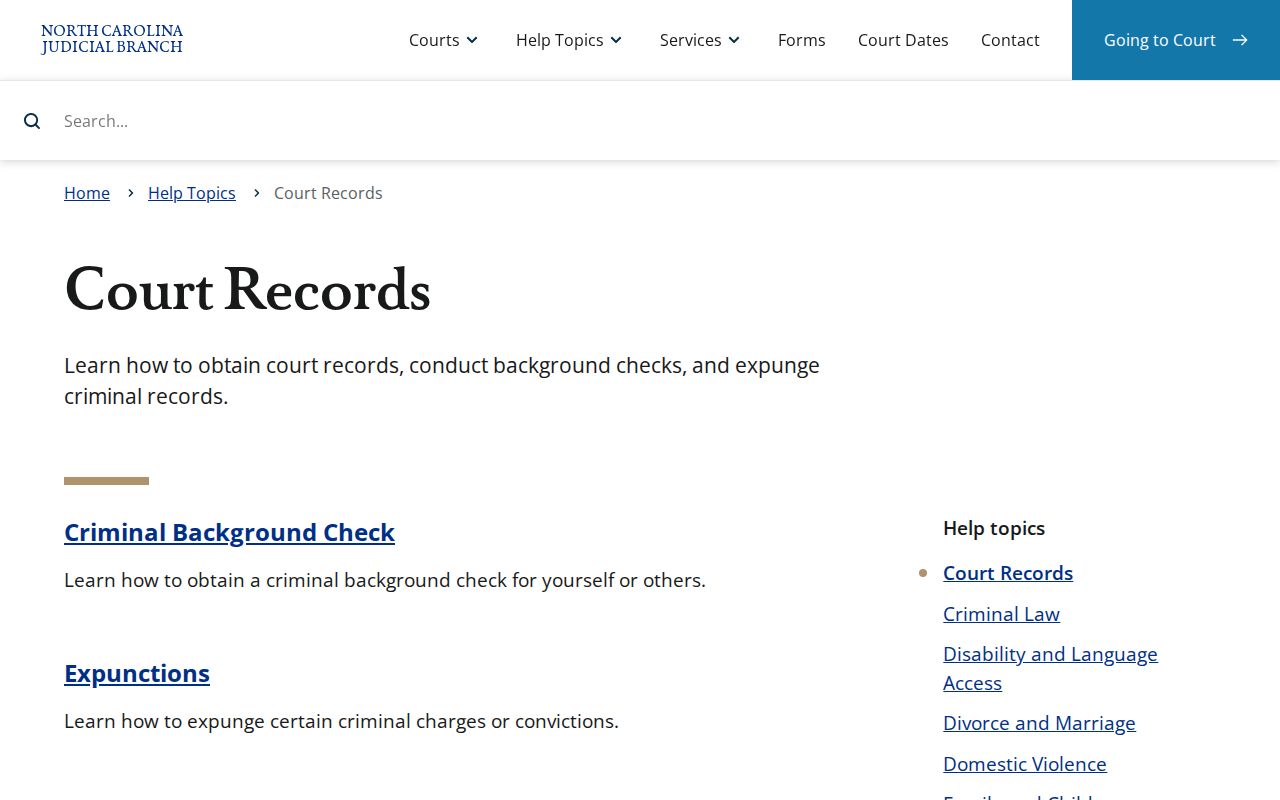
That distinction matters because a public electronic view does not carry the same certification as a clerk-issued record.
Read Stokes County Case Outcomes
Status words must be read in context. Pending means the court has not posted a final result. Disposed means the case or charge has reached an outcome, but the disposition field must be opened to learn what happened. Dismissed means that charge ended without a conviction. Not guilty or acquitted also means no conviction on that charge. Guilty calls for review of the judgment because one file may contain several charges with different outcomes.
- Arraignment
- The proceeding where the formal charge and plea are addressed.
- Disposition
- The recorded result of a charge.
- Remanded
- A case or issue sent back or moved to the proper forum.
- Indictment
- A grand jury's formal felony accusation.
An arrest charge can also differ from the charge filed by the district attorney. Use the court file, not the booking label, to understand what was prosecuted. For the earlier custody record, consult the county's Stokes County arrest history resource.
Stages of a Criminal Case
A Stokes County criminal matter may begin with a citation, arrest, or other process. A magistrate handles initial process and release functions. District Court resolves misdemeanors and manages preliminary felony work. A felony that proceeds by indictment or transfer reaches Superior Court for arraignment, motions, plea negotiations, or trial. The judgment fixes the disposition and sentence. Later appeal or probation filings can add more entries to the same history.
Case flow: Charges Filed › Arraignment › Pretrial › Plea or Trial › Disposition › Sentencing
This sequence is a map, not a promise of timing. Some charges end early, some cases have several hearings, and related charges can move on different tracks.
Older Stokes County Court Files
Stokes County's July 2025 eCourts conversion created a practical line between paper-era and newer electronic material. The portal may index an older matter without displaying each item that remains available at the courthouse. Under G.S. 7A-109, nonconfidential clerk records are open during regular office hours. Courthouse public computers also allow free noncertified county or statewide searching, though printed pages may carry a charge.
If a Stokes County criminal case is absent online, preserve the person's full name, birth date, likely filing year, charge, and any old case number. Call 336-593-4400, mail the clerk at PO Box 250, Danbury, NC 27016, or inspect the record at 1012 Main Street on weekdays from 8:30 a.m. to 5 p.m. Staff can locate existing records but cannot create a new analysis of them.
Certified Stokes County Case Searches
The clerk's certified criminal-record search is county-specific. Submit AOC-CR-314 with the $25 fee to the Stokes County Clerk of Superior Court. Mail submissions use a money order or certified check. At the counter, the listed options are cash, card, money order, or certified check. The form and fee purchase a clerk-conducted Stokes search, not a fingerprint-supported statewide SBI record.
The official AOC-CR-314 page pictured below provides the current form source.
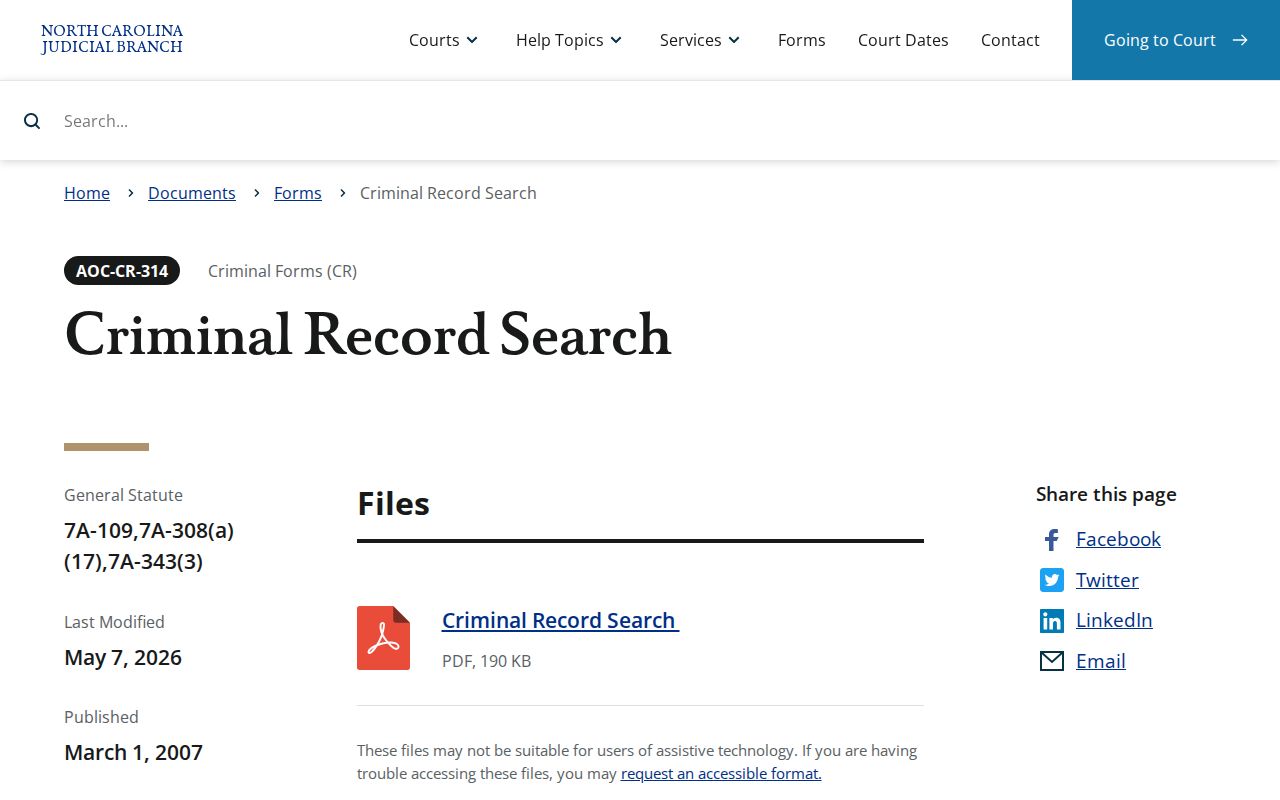
Check the current version before mailing so the clerk receives the right identifying details and payment.
Stokes County Court Payments
Search fees, court costs, and case balances are different obligations. The Stokes County payment page lists local cashier methods and should be checked before a visit or mail payment. A portal financial line can help identify a balance or category, but it does not itself prove that payment was accepted or that every condition of judgment has been met.
The local payment information page is shown below.
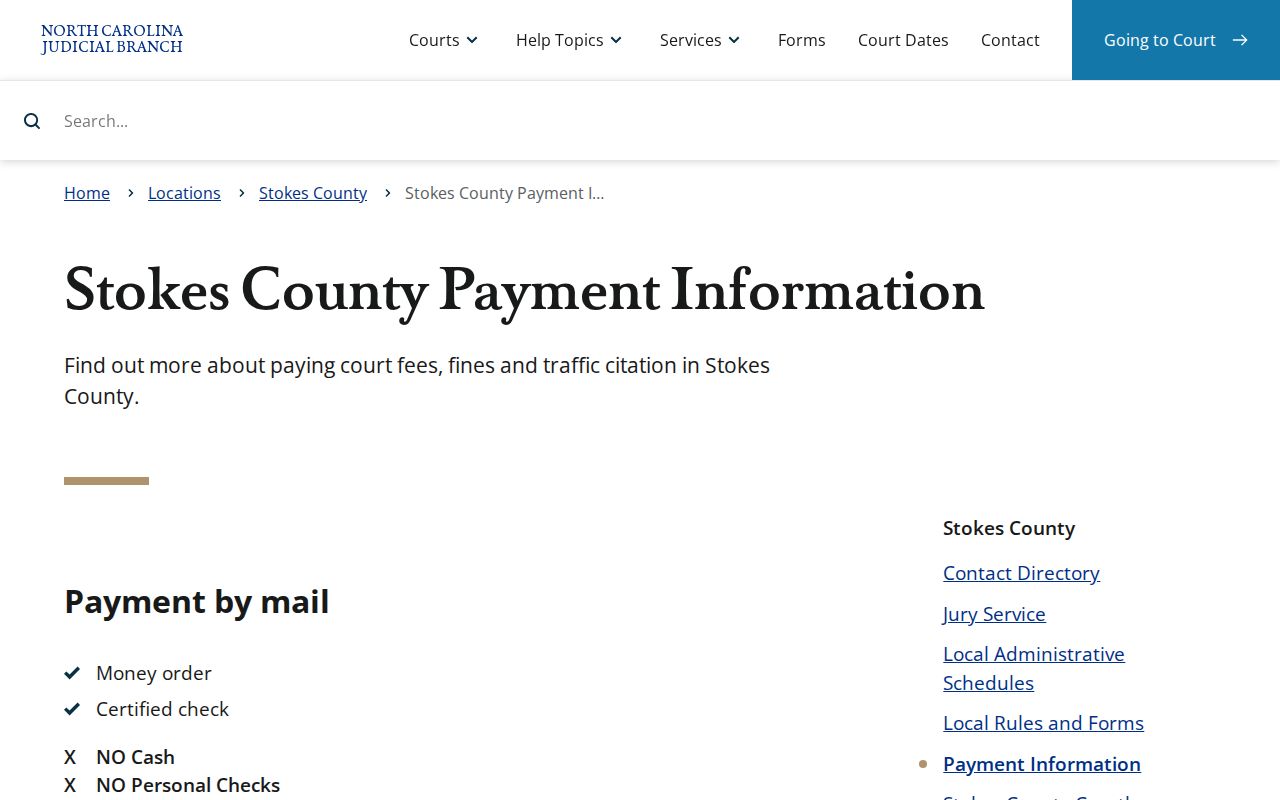
Keep the case number with any payment question so the clerk can distinguish the right Stokes County file.
Access & Restrictions
North Carolina generally opens nonconfidential criminal actions and judgments at the clerk's office. Portal extends access to public electronic fields, but anonymous users cannot see sealed documents or protected data. Juvenile matters, expunged records, protected victim information, Social Security numbers, account identifiers, and other confidential material do not become public merely because a related case exists.
A missing Stokes County result may reflect an identifier mismatch, a paper-era file, a reporting delay, restricted access, or lawful expunction. It is not sound proof that no case exists. Ask the clerk about the search route and provide enough detail to identify the file. For a statewide fingerprint record belonging to the requester, use the North Carolina SBI Right to Review process instead of treating Portal as a rap sheet.
Access rule: G.S. 7A-109 opens nonconfidential clerk records during regular hours, while Chapter 132 exceptions and criminal-procedure laws protect specific data and files.